

Externalising Anger: How We Used a Volcano to Understand Big Feelings

Written by : Bianca Verdi | MA. In Counselling
Modality: Experiential Play Therapy / Externalisation Intervention
Target Concern: Affect dysregulation, explosive anger episodes, and somatic emotional awareness.
"Inside the therapy room, my priority is rarely to talk a child out of their anger. It is to offer a container steady and non-judgmental enough to hold it"
When working with children prone to intense emotional outbursts, families often describe these moments as sudden and unpredictable—like walking into an explosion without warning. Yet sitting alongside these young people, I see a different reality: a nervous system quietly accumulating pressure and sensory fatigue long before the first drop spills over.
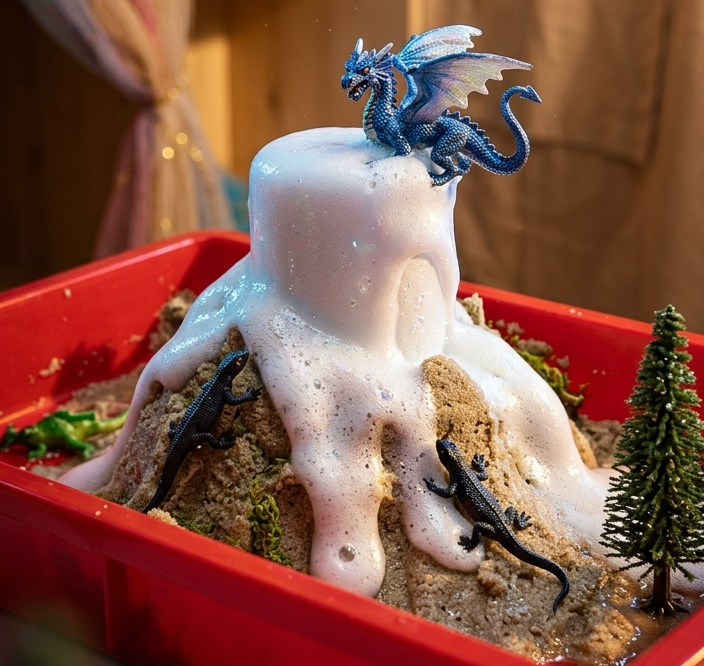
To make sense of this without triggering defensiveness, I often turn to experiential play and externalisation. In the middle of autonomic overwhelm, verbal processing can feel confrontational or cognitively inaccessible. By constructing a physical model using kinetic sand, bicarbonate of soda, and miniature figures, we lifted the emotional charge out of the child’s body and placed it safely onto the table. It invited us to become co-investigators of the nervous system together, uncoupling dysregulation from shame.
Mapping the Inner Landscape: The Volcano Metaphor
During our session, we assigned shared meanings to each physical component of the exercise:
The Volcano Structure (The Body): Grounds emotional experiences somatically, helping the child recognize where feelings physically live, register, and build inside us.
Bicarbonate of Soda (The Buildup): Represents cumulative daily micro-stressors and sensory fatigue—losing a turn, rushing through a morning routine, or subtle peer friction.
The Vinegar (The Tipping Point): The acute trigger that pushes the nervous system over capacity, such as an unexpected boundary or feeling misunderstood.
Surrounding Figures (The Relational Ecosystem): Illustrates the family, friends, and social circle naturally impacted when dysregulation erupts uncontained.
When the vinegar met the bicarb, foam erupted across the tray, toppling the figures resting in the sand.
The shift in the room was immediate. The child paused, looking up with genuine curiosity rather than guilt. The physical metaphor landed with gentle clarity: the chemical reaction itself isn't bad or forbidden, but an uncontained eruption can unintentionally knock over the people we love.
From this shared baseline, we explored proactive cooling strategies to support the body before reaching that tipping point:
Sensory Grounding: Using tactile inputs (such as resistance putty or textured squishies) to discharge motor tension safely through the body.
Physiological Pacing: Practicing low, slow exhalations to stimulate the vagus nerve and downshift internal physiological arousal.
Proactive Co-Regulation: Introducing simple, low-demand phrases to signal for an adult's calming presence before the feeling becomes insurmountable.
Holding Boundaries During Transitions
Even therapeutic play involves friction. When the session shifted toward cleaning up the tray, the transition naturally sparked resistance and boundary-testing. In early intervention, this is not defiance; it is diagnostic. It shows that moving from deep, preferred engagement back into structural limits requires deliberate safety and predictability. By holding the frame through visual countdowns, grounded non-verbal presence, and relational consistency, the client was able to regulate through the end of the hour.
Self-Reflection: The Art of Holding Space
Therapy is not about extinguishing big emotions or demanding behavioral compliance. It is about creating conditions where a child feels safe enough to witness their own internal landscape.
Children who carry a reputation for "explosions" frequently internalize the belief that they are defective, broken, or dangerous to be around. When we externalize their distress into sand and foam, the atmosphere in the room softens. The child stops being the problem and becomes an ally, looking at the problem alongside me.
Doing this work requires the therapist to act as the primary anchor. If I meet messiness—whether fizzy vinegar on the table or resistance during a tough transition—with anxiety or urgency, the child absorbs that dysregulation. By remaining unhurried, calm, and curious, my nervous system serves as a temporary scaffold for theirs.
Ultimately, this work is rooted in dignity: sitting on the floor amidst spilled sand and vinegar, showing a child that their biggest, most overwhelming feelings are not monsters to fear, but human experiences we can navigate together.


Comments